


Table of Contents
Introduction
Article 1 – 5-minute beginners guide to surfing equipment
Common Questions
Article 2 – How difficult is it to learn to surf?
Article 3 – How late is too late to start surfing?
Article 4 – Is surfing an expensive hobby?
Surfboards
Article 5 – Surfboards: How to choose a surfboard?
Article 6 – Surfboards: What are surfboards made of and how do I take care of them?
Article 7 – Surfboards: Which size surfboard should a beginner use? Why?
Article 8 – Surfboards: What’s a good beginner’s surfboard to buy?
Other Equipment
Article 9 – How to choose a surfboard leash (legrope)
Article 10 – Why do surfboards have fins?
Article 11 – Why do surfers put wax on surfboards?
Article 12 – Surfboard Tail Pad & Boardbag. Do you need them?
Article 13 – What wetsuit should I buy?
Extras
Article 14 – Top 15 Mistakes When Buying a Surfboard Setup
Article 16 – How and Where Should I Start Learning to Surf?
Article 17 – Top Ten Resources to Teach Yourself to Surf
Article 18 – Where to Learn to Surf
Article 19 – What are the Best Surf Schools?
Article 20 – What is the best time to surf?
Article 21 – What are the Best Surfer Hacks?
Article 22 – What are some things that you shouldn’t do while surfing?
Article 23 – What should surfers do to be safe?
Article 24 – How often do surfers break surfboards?
Article 25 – How to position your surfboard – in and out of the water
One of the most fundamental components of surfing, and one which many beginners struggle with, is related to positioning their surfboard. This applies in many different situations – go to any beginner beach and you’ll see new surfers struggling to lug their boards from the car park to the water. Look out to sea and you’ll see people sitting or lying on their boards incorrectly while waiting for a set, and others incorrectly positioned on their board as they attempt to paddle into a wave. The first of these is mostly an inconvenience and may cause some a little embarrassment, while the latter can severely impede your ability to progress as a surfer, so we’re going to tell you all you need to know to avoid these situations.
How to carry your board
Carrying your surfboard might not sound like something that you need to learn how to do, but you’d be surprised at how many people can’t quite perfect the art. This is particularly so given that in general, inexperienced surfers will be the ones lugging around the biggest boards, and carrying a nine-footer without looking silly is a little more difficult than carrying a lightweight shortboard.
You’re probably thinking that it can’t be all that hard – don’t you just stick it under your arm and start walking? In simplified terms this is correct, but the reality is a little more nuanced. For starters, you need to get the board facing the correct way. In general, you should be carrying the board forward first, so that the fins are behind you, with the bottom of the board resting against your body.
From there, it’s mostly a matter of finding the midpoint of your board so that it doesn’t tilt either forwards or backwards. This is simply a matter of trial and error, and while it’s pretty straightforward if you don’t have a big board, with a longer board it’s a little more difficult when you’re not accustomed to doing it.
Occasionally, you’ll see beginners (usually in surf classes) carrying two longboards between two of them – one at the front carrying the nose of a board under each arm, and the other at the back carrying the two tails. This can be a useful trick if, a) you have multiple people and multiple boards to carry, and b) if your arms struggle to reach around the entire deck of the board at its widest point. Boards are narrower towards the nose and the tail so can be a little easier to carry there – again, however, this technique is only appropriate in specific situations and you’ll still need to learn how to carry a board by yourself.
How to position yourself on your board in between sets
There’s often a lot of waiting around while surfing, and while once you’re an accomplished surfer you’ll know how to rest on your board, initially it can feel a little unnatural. There are two options – lying on your stomach or sitting up on your board. If you look out at a line-up you’ll see that the vast majority of surfers are sitting on their board in between sets, and this is what you’ll likely end up doing too, but often beginners choose to rest on their belly as they struggle to find their balance sitting up on their board.
Lying down is fine, and all it requires you to do is find the position on your board which will have the nose resting just above the surface of the water. Eventually, however, you’ll probably want to learn how to sit on your board.
When you first try to sit upon a floating board it feels a little strange, and you might endure some embarrassing moments where you tip over – but shake it off, you’ll figure it out sooner rather than later. The best advice I received when I was in this stage was to relax – I was so busy wriggling around trying to find the perfect spot on the board and shifting my weight in strange ways that I didn’t realise that all I needed to do was fully commit to sitting around the middle part of my board, just as I would on a stool, and I wouldn’t tip over.
There is some trial and error required – if you sit too far forward and the nose is a long way under the water you’ll keep tipping forward, while if you’re so far back that the nose is a metre in the air the opposite will happen. On a relatively buoyant board with a bit of length though (the kind that you’ll likely be surfing as a beginner), there is a fairly substantial part of the board on which you can sit without any troubles.
How to lie on your board when paddling for a wave
-
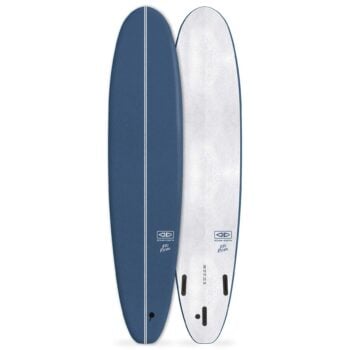
 Ocean and Earth Bug Softboard 5’2$360.00
 -
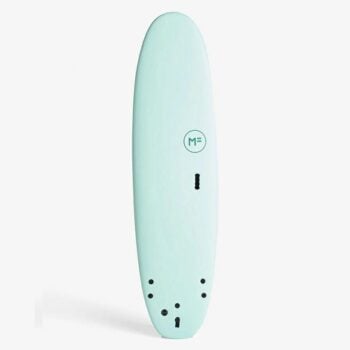
Mick Fanning Softboards Mick Fanning MF Mini Beastie Supersoft 6’0$595.00
-
Ocean and Earth Bug Softboard 4FT$225.00
-
Mick Fanning Softboards Mick Fanning MF Beastie Super Soft 9’0$595.00
-
Mick Fanning Softboards Mick Fanning MF Beastie Super Soft 8’0$625.00
-
Ocean and Earth Ezi-Rider 2.0 Softboard 9’0$655.00
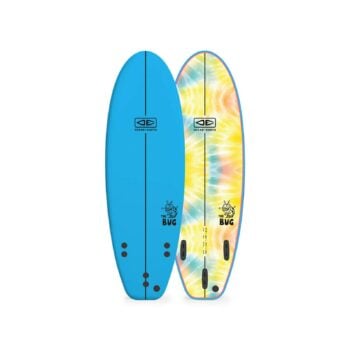
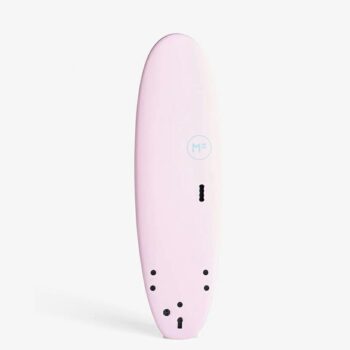
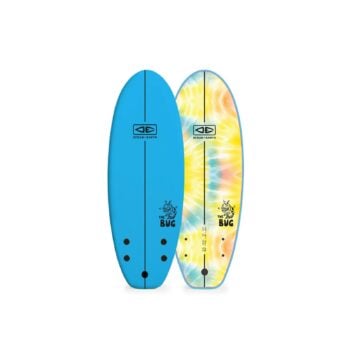
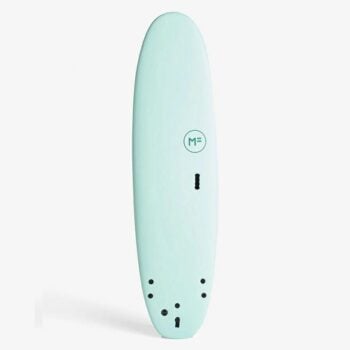
Perhaps the most important part of positioning, this is also what beginners tend to get wrong the most often. This is all about finding the happy medium – the two errors you can make are to be too far forward or too far back, both of which will result in you failing to catch the wave you’re paddling for.
More often than not, people who are new to surfing will be too far back on their board when paddling for waves initially, something which is an understandable sign of their tentativeness. You can tell someone is a little too far back because the nose of their board will be well above the water’s surface, and they won’t paddle very fast. The end result is that, unless you are right where the wave is breaking, you’ll find that the looming wave will slip underneath you and you’ll fall off the back of it.
And so, you need to adjust by moving further towards the nose. Go too far, however, and you’ll have the opposite problem. The next wave that comes along might pick you up, but you’ll quickly notice your nose heading directly towards the ocean floor and you with it. This is aptly called a nosedive, and is a common occurrence among beginner surfers.
In between these two is exactly where you want to be. When you’re in the correct part of your board to paddle into a wave, the nose of the board will be just above the surface of the water – if it’s underneath the surface or bobbing in and out of the water, you’ll probably nosedive, while if it’s flailing way up in the air you won’t go anywhere. Find the part of your board which results in the nose hovering just above the surface though, and you’re probably around the mark.
Once you learn how to master the techniques in these three situations, you’ll start to feel a lot more comfortable with your surfboard. The first couple might be more about avoiding embarrassment than anything else, but this is key to building your confidence, while your positioning when paddling for a wave will have a tangible impact on your ability to progress.

