


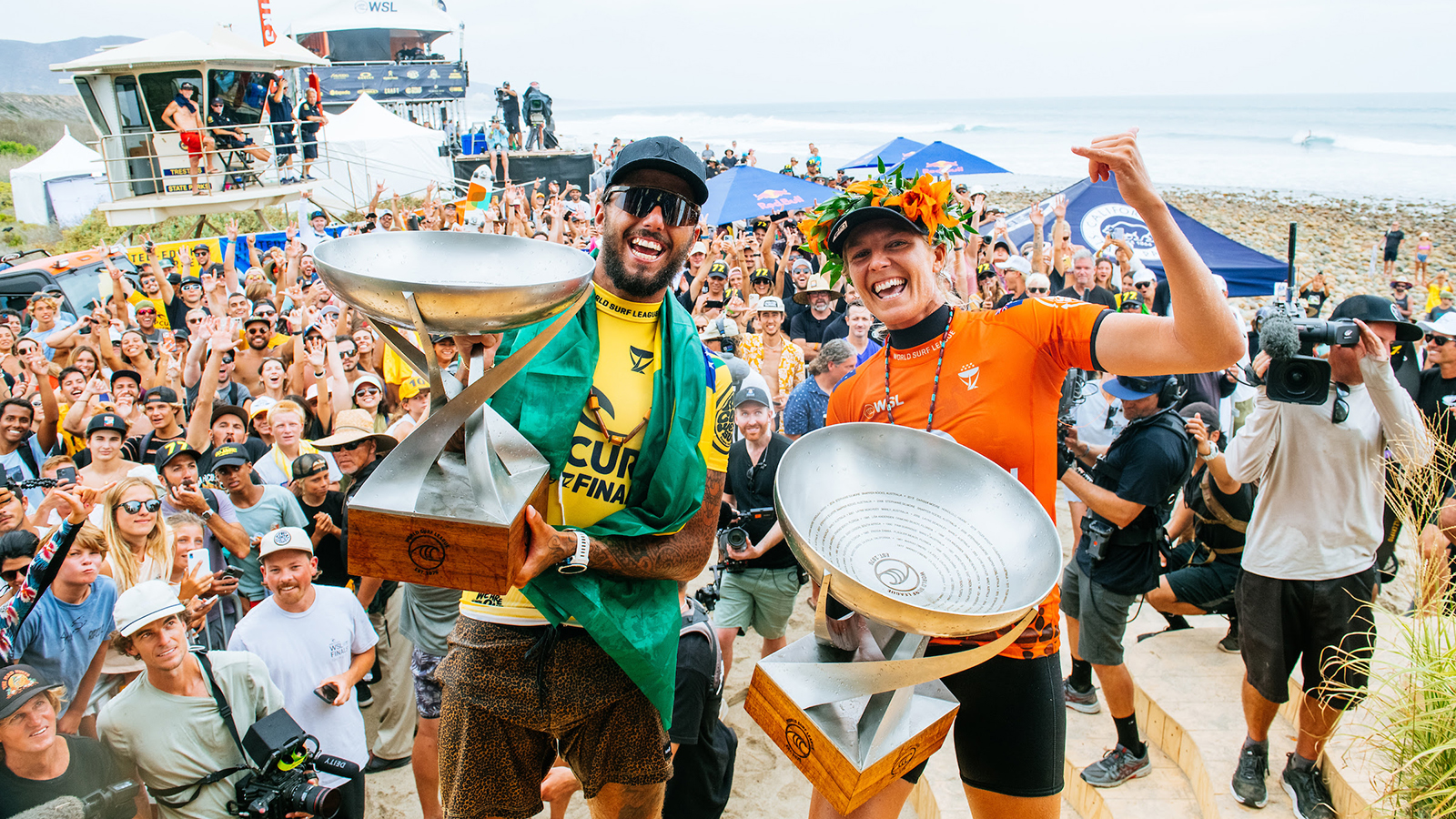
After a pulsating WSL Finals Day to determine the 2022 world champions – a day which culminated in Stephanie Gilmore winning a record eight title in incredible fashion, and Filipe Toledo breaking through first his first – the professional surfing world’s head has turned to the next season. Set to kick off in late January, the 2023 season will see both the male and female tours head to ten different world class destinations, before the WSL Finals will again take place in September. The schedule is, for the most part, very similar to this year, albeit with one notable exception, and will for the second time see both the men and women compete in the same events. Let’s take a look at all ten of those events, when the event window will run, and what you can expect from them.
Billabong Pro Pipeline (January 29 – February 10)
The season will begin, as it has for the last couple of years, with the Billabong Pro Pipeline. Perhaps the most well-known wave in the world, this is some way to start the season, and last year saw one of the most incredible results in recent memory when Kelly Slater, aged 50, won the event, along with the little known Moana Jones Wong. The heavy, barrelling wave favours a certain type of surfer, with surfing the open face something which will have to wait for other events.
Hurley Pro Sunset Beach (February 12 – 23)
The Hurley Pro Sunset Beach returned to the tour last year after 12 years of absence on the women’s side and 19 on the men’s, and in 2023 will return as the season’s second event. Last year saw another pair of unlikely winners, this time in the form of Brisa Hennessy and Barron Mamiya, who won out in heaving, unruly conditions. After the barrels of Pipe, this will be the first opportunity for competitors to show their wares with a bit more wave to work with, though the conditions which are served up can vary fairly drastically here.
MEO Portugal Pro (March 8 – 16)
Last year’s MEO Portugal Pro was the first since 2019, and while it had been a staple for the men for a decade prior to that, that 2019 event was the first for the women since 2010. Tatiana Weston-Webb turned around a slow start to the season by winning here last year, while for the men it was Griffin Colapinto claiming the victory. Supertubos, where this event takes place, is the second barrelling wave in the first three events, but while it has no shortage of power, it doesn’t compare to Pipeline in terms of danger rating. The sandy-bottomed break is an A-Frame offering up both left and right-handers, and an ability to get up and generate speed quickly is paramount.
Rip Curl Pro Bells Beach (April 4 – 14)
The 2021 season was the first time since 1976 that the Rip Curl Pro Bells Beach wasn’t held, but it returned with a bang last year, with two of the best surfers of this generation ringing the bell come tournament’s end. Those two surfers were Filipe Toledo, who of course ultimately went on to win the world title, and Tyler Wright, who was looking like competing to do the same until things went pear-shaped for a number of reasons in the back half of the year. Conditions at Bells are vastly different to the first three events; this is a long right-hand point break, offering ample wall on which the pros can make their mark. Bells is able to remain a relatively similar wave regardless of the size, but at its best can deliver huge conditions which demand plenty of commitment from the athletes.
Margaret River Pro (April 20 – 30)
The Margaret River Pro is another stalwart of the tour and more specifically the Australian leg, having first taken place in the ‘80s for both the men and the women, and every year since 2014. Last year it was an Aussie duo doing the double, with local Jack Robinson reminding us of just how good he is at his home break, and Isabella Nichols winning her maiden CT event. There are a couple of different breaks here which can be utilised depending on conditions, but regularly this is a big and heavy break, so those comfortable in waves of consequence typically do well.
Surf Ranch Pro (May 27 – 28)
To the delight of some and the chagrin of many others, the Championship Tour will next year return to the mechanical world of Kelly Slater’s Surf Ranch for the Surf Ranch Pro. This event has taken place three times in history, and on the men’s side has seen remarkably similar results, with Gabriel Medina and Filipe Toledo making the final on every occasion. The women’s side has seen a bit more variance, though Carissa Moore and Johanne Defay have made two of the three finals each. This event gives competitors a chance to show what they can do on both a perfect left and a perfect right, making it a vastly different viewing experience to every other event on tour.
Surf City El Salvador Pro (June 9 – 18)
Last year was the first time that the Surf City El Salvador Pro appeared on tour, and it must have been popular enough, because it will return in 2023. Last year, Griffin Colapinto won his second event for the year here while Steph Gilmore began her charge towards an eight title. The event takes place at Punta Roca, which is a world-class right-hander which runs for hundreds and hundreds of metres, often barrels, and regularly gets compared to J-Bay. Unfortunately, last year it didn’t turn it on like it is capable of, but if conditions come at the right time this could be one of the most watchable events on tour.
Rio Pro (June 23 – July 1)
The Rio Pro first took place in 1976 for the men and 1977 for the women, and though it hasn’t run every year since, it has been a common feature of the tour and has run every year since 2011 – with the exception of the COVID-affected 2021. Filipe Toledo won his third title in a row here last year and his fourth in total, while Carissa Moore won her second title in the Brazilian capital. This beach break at Saquerema offers a bit of a change from the barreling reefs and right-hand point breaks so prevalent on the tour, with a more variable range of waves on offer – albeit also more fickle.
Corona Open J-Bay (July 13 – 22)
Some would argue that there are too many right-hand point breaks on tour, but if any are going to be removed it certainly won’t be J-Bay. This event has been a mainstay of the men’s tour nearly every year since 1996, while the women re-joined it in 2019. It was another victim of the amended 2021 tour schedule, but returned last year to see Tatiana Weston-Webb win her second event of the year, and talented young Aussie Ethan Ewing win the first of his career. The jewel in South Africa’s surfing crown, this right-handed point break is about as close to perfection as you’ll find in the ocean. Add in a good chunk of wildlife and you’ve got one of the most enthralling events of the season.
SHISEIDO Tahiti Pro (August 11 – 20)
The 2023 season will end the way it began – with a big, heaving, and downright scary left-hand barrel breaking over razor sharp reef. It’s been on tour every year except 2021 since 1999 for the men, though for the women last year was the first event here since 2006. Courtney Conlogue was the winner of that return to Tahiti, while Miguel Pupo very nearly made an extraordinary last-minute leap into the top five by winning the first event of his career. This wave can get very big and very hairy when it’s on, and with spots at the WSL Finals up for grabs, will be a must-watch event.
WSL Finals, Lower Trestles (September 7 – 15)
For the third time, the world champion will be determined in 2023 by a WSL Finals event at Lower Trestles. Rather than the top ranked surfer at the end of the season being crowned the winner, the top five will instead be sent here for a winner-takes all event. With the event all taking place within a solitary day, day-long offshores are evidently in order, but fortunately the consistency in this part of the world at this part of the world is close to unmatched.
The 2023 WSL Championship Tour season won’t see a huge departure from this year’s tour, with the addition of the Surf Ranch Pro at the expense of the Quiksilver Pro G-Land. It’s again a tour dominated by big barrelling reef breaks and right-hand points; that may be a little monotonous, but fortunately, the quality of those waves more than compensates.

